
5 min read
Beatwired is on the App Store now, for iPhone. It's a rhythm-based regulation tool for ADHD brains: you check in, get a drum pattern suggested for how you're feeling, and play along for about ten minutes with a video of a drummer and a steady metronome. No drums required. A pillow and ten minutes will do.
This post walks through what the app is, who built it, and what it costs. The short version on cost: the check-in, the session timer, the metronome, and three starter patterns are free forever.
Who built Beatwired?
A father and son. The father is a lifelong drummer and a physician of nearly twenty years. He put drumsticks in his son's hands at age three. The son grew up with ADHD, and while interests, hobbies and plans came and went, the drums stayed.
Beatwired is built around what the drums were in their house: something steady to hold onto on a hard day. The full story is on the home page.
What happens in a session?
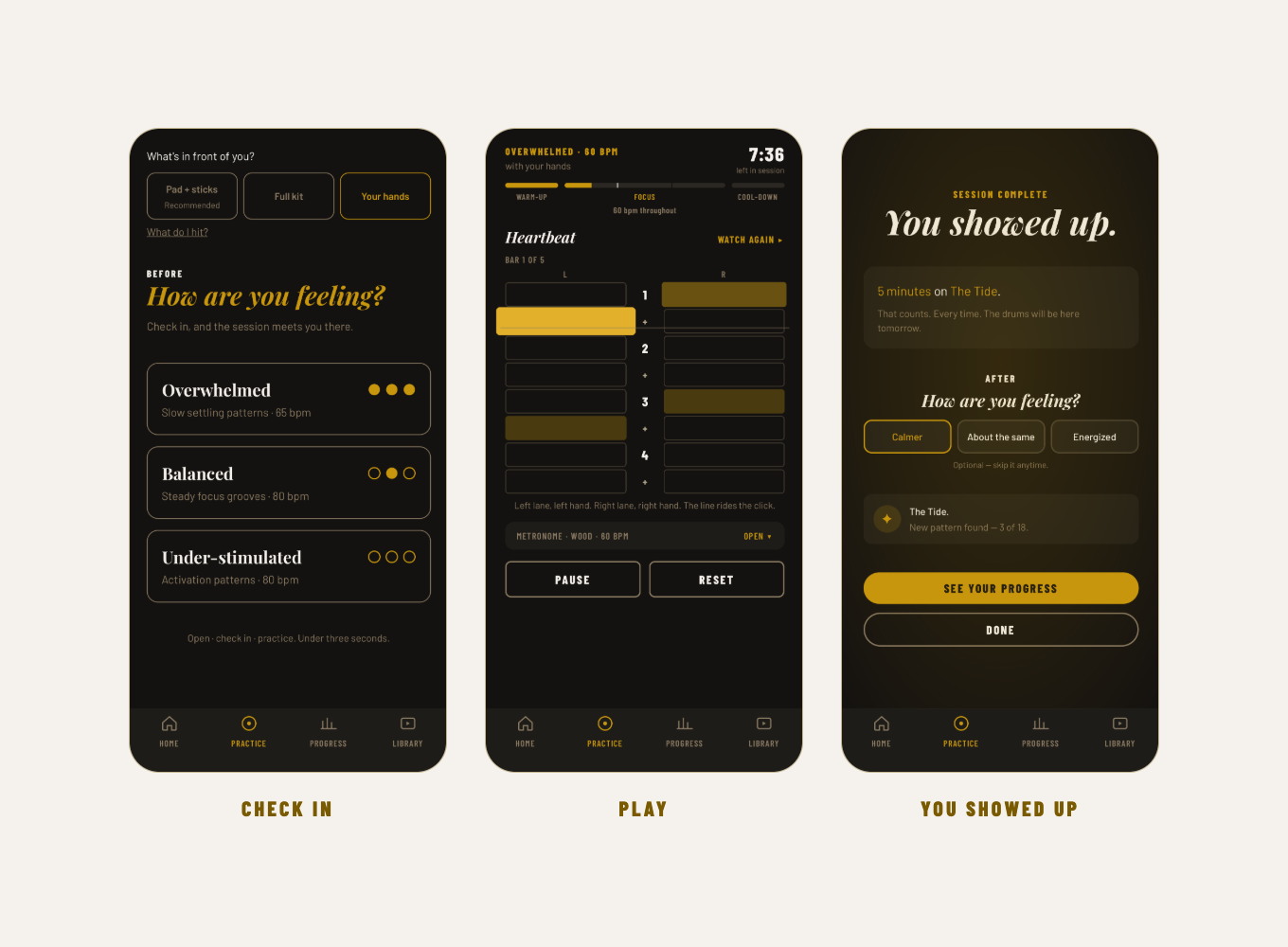
The check-in, the session screen, and the session complete screen.
Every session starts with one question: "How are you feeling?" There are three answers: overwhelmed, balanced, or under-stimulated. Many tools only ask about stress. The third answer is there because under-stimulation is a real state too, the flat, restless one where nothing will start. We wrote about it in Under-stimulated is a real state.
Your answer suggests a pattern and a shape for the session. An overwhelmed session starts slow and settles slower. A balanced session climbs and comes back home to where it began. An under-stimulated session climbs and ends faster than it started.
The suggestion is only that. Any pattern in your Library is yours, any time, and you can switch patterns in the middle of a session. Nothing unlocks by performance, and there is nothing to win or lose.
Then you play along. Sessions run about ten minutes, with a warm-up, a focus section, and a cool-down, and short cards between them tell you what's coming next, like a tempo change or two bars of rest.
Near the halfway mark, one quiet line appears: "Good stopping point if you need it." Stopping still counts. The thinking behind that line is in The halfway stopping point.
Whenever you finish, the app says "You showed up." Then it asks how you're feeling again, so you can see where you started and where you ended.
How do I learn a pattern?
Watch the demo, then follow the grid. Every pattern in the Library has a short looping video of a drummer, filmed from above, and every pattern is filmed three ways: on a drum kit, on a practice pad, and with bare hands on a tabletop. The videos have no talking, only the playing and the metronome click. Under each video sits the rhythm grid: two lanes, one for each hand, showing which hand plays when. Reading the rhythm grid walks through how it works.
What will I see while I play?
The session screen is simpler than the Library. It shows the rhythm grid, with cells lighting up in time with the metronome, the metronome itself, and a bar showing where you are in the session. The video isn't on screen while you play. If you want to see the pattern again, tap "Watch again" and it comes up while the session keeps running.
The metronome keeps a steady beat the whole way through. You can mute it and the grid keeps time without it, or nudge the tempo up or down and the session follows. Metronomes have been doing this one job for two centuries, and we wrote up that history in The metronome: two centuries of one steady job.
The grid pulses with the beat, and we know pulsing visuals aren't for everyone. If you turn on Reduce Motion in your phone's settings, Beatwired follows it: the cells stop flashing, and only a single line glides down the grid to keep your place.
What do I play on?
Anything. Thighs, a tabletop, a pillow. Every session works with no gear at all, and a pillow is a fine place to start. A practice pad and a pair of sticks, about $55, add rebound: the pad bounces the stick back up for you, so faster or longer patterns stop feeling like arm exercise. If a drum kit already lives in your house, every pattern has a kit video, and headphones solve the volume problem. The full gear story, including what a pad adds and when it's worth buying, is in Rhythm, no drumming experience needed and on Get Started.
How does the app keep track?
Progress shows three numbers: your day streak, your total minutes, and your patterns found, which is how many of the eighteen patterns you've played at least once. The streak is gentle: today never counts as missed until it's over, and after a gap the app says "You're back. New streak starts now." Total minutes and patterns found only ever go up. The design behind that is in "You're back".
There's no account to make, and nothing leaves your phone. Your sessions, streaks and check-ins are stored on your device only. We don't collect them, we can't see them, and no one is watching how often you practice.
What's free?
The check-in, the session timer, the metronome, and three starter patterns are free forever. So are your streak and your total minutes. There are no ads, in the free version or anywhere else.
The three free patterns cover the three check-in answers. Overwhelmed suggests Steady Quarters at 65 beats a minute. Balanced suggests Doubles at 80. Under-stimulated suggests Paradiddle at 80. Whichever way you feel when you open the app, the free version has a session built for it.
We made the free part permanent, not a trial, on purpose. A lot of people with ADHD have a phone full of apps they meant to keep using. A free version that runs out becomes one more thing to feel behind on. This one doesn't run out.
What does Pro add?
The full library of eighteen patterns, with every video: kit, pad, and hands. Pro is $49.99 a year or $7.99 a month, after a 7-day free trial. You can cancel anytime in your phone's subscription settings.
Is Beatwired a treatment?
No. Beatwired is a practice tool, not a medical treatment. It doesn't replace medication, therapy, or a clinician, and the app itself hasn't been studied.
What is established is that ADHD brains show real, measurable differences in timing, and rhythm training is one of the most direct ways to work those exact systems. The research is early and promising, and we lay out exactly what it says, and what it doesn't yet, on The Science, sorted by strength of evidence.
That's Beatwired. Ten minutes, on your terms.